
 Share
Share  Share
Share  Share
Share The Department for Education (DfE) has recently released the Technology in Schools Survey 2024 to 2025. At first glance, the national picture looks positive. Schools are improving device access, updating hardware and meeting more of the DfE digital standards. Connectivity is also improving across many primary and secondary settings.
However, when digging deeper into the data, a complex challenge emerges. While internet connections and hardware are improving, the staff expected to use them are feeling less confident and receiving less training than they did two years ago.
For school and trust leaders, this disconnect poses a risk. Edurio’s Staff Experience Report confirms that overwhelming workload remains one of the top reasons staff consider resigning. Technology should be the solution to this workload crisis, but the DfE data suggests that without the right support, it can become just another pressure point.
Here is what the national data says and how you can uncover the specific barriers within your own trust.
What the national DfE data shows
The confidence gap: infrastructure is up, confidence is down
Schools and trusts are making real progress with their hardware. Awareness of and adherence to the DfE’s digital and technology standards have increased significantly across both phases. Furthermore, fewer primary leaders now cite broadband or Wi-Fi connectivity as a barrier to technology uptake compared to 2023.
Additionally, 55% of respondents in the BESA Compass Report Autumn Term 2025 agreed that their school has a long-term plan in place for the maintenance of its technology infrastructure.
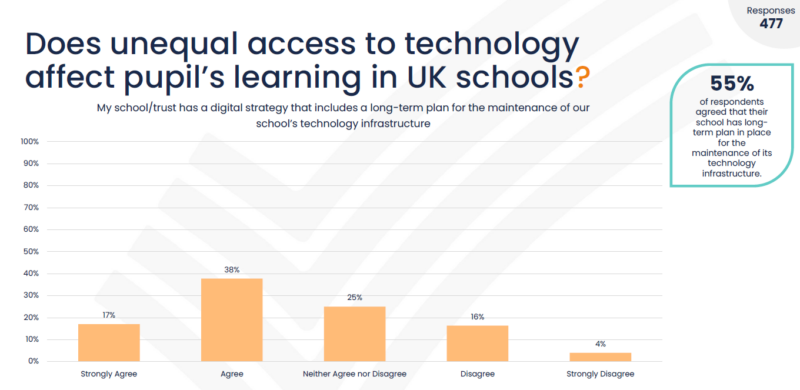
Source: Compass Report Autumn 2025 – British Educational Suppliers Association (BESA)
However, while the technology is ready, the workforce is feeling less prepared.
- Confidence is falling: the proportion of leaders reporting that more than three-quarters of their teaching staff were confident using technology fell from 53% in 2023 to 40% in 2025 in primary schools, and from 58% to 44% for secondary schools.
- Training uptake has dropped: overall, the proportion of teachers who had undertaken any education technology training in the past 12 months fell slightly, from 70% in 2023 to 64% in 2025.
This suggests a widening gap: investing in infrastructure alone does not guarantee staff feel capable of using it.
Technology can reduce workload when it is used well
Despite falling confidence, the DfE findings show that digital tools can have a positive impact on teacher workload when adoption is successful.
- 61 per cent of leaders and 43 per cent of teachers say technology has reduced workload in the last three years.
- 74 per cent of leaders and 50 per cent of teachers expect technology to reduce workload further in the next three years.
The biggest time savings reported include:
- Parental/carer engagement and communication (76% of leaders).
- Pupil/student data management (73% of leaders).
- Collaborating and sharing resources (72% of teachers).
These match areas where staff consistently express workload concerns in Edurio data. This suggests that the potential for technology to support retention is real, but unevenly experienced.
The new barriers: skills and security
The TiSS data highlights that budgetary constraints remain the primary barrier for 95% of leaders. However, two barriers linked to staff experience have grown rapidly since 2023.
- Safeguarding and data concerns: this is becoming a significant worry. The proportion of leaders citing this as a barrier nearly doubled from 25% in 2023 to 49% in 2025 for primary schools, and rose from 28% to 52% for secondary schools.
- Staff skills: the lack of staff skills and confidence is now cited as a barrier by 67% of primary leaders (up from 60%) and 70% of secondary leaders (up from 60%).
What the DfE survey does not tell you
The national findings are valuable, but they cannot show leaders what is happening within their own trust or individual schools. They do not answer questions such as:
- Which digital tools do your teachers feel least confident using?
- Are confidence issues caused by unreliable devices, confusing expectations or limited training?
- Do staff feel comfortable using AI as part of their practice?
- Are inclusion tools, such as assistive technology, available and effective?
- Do pupils have dependable access at home for digital homework?
To act on the national picture, leaders need a clear understanding of their own staff experience.
How a digital technology survey helps you understand your local picture
A trust-wide Digital Technology Survey, such as Edurio’s Digital Technology Survey for Teachers, provides the insight needed to understand how teachers experience technology in daily practice. It does not promote any particular technology. Instead, it focuses on the conditions that shape staff confidence and the factors that influence whether digital tools support or hinder their work.
A school-level survey can help leaders understand:
- Skills & training needs: moving beyond generic feedback to identify specific gaps in digital capability.
- Technical reliability: measuring how often connectivity or device failure is actually disrupting lessons.
- AI confidence & usage: understanding if staff are embracing new tools for workload reduction or avoiding them due to a lack of training.
- Inclusion & assistive tech: verifying if the right tools are available and effectively used to support pupils with SEND.
- Classroom management: assessing if devices are aiding learning or becoming a source of distraction.
This creates a detailed and practical understanding of staff confidence at a school level. It allows leaders to move from awareness of a national issue to identifying the specific barriers that matter in their schools.
Explore the Digital Technology Survey
Are your digital tools actually helping? Don’t look at data in isolation. Combine your Staff Experience insights with our Digital Technology Survey to bridge the gap between IT investment and team satisfaction.
How leaders can use digital technology survey results to drive improvement
Once trust leaders have local evidence, they can take meaningful action.
- Target investment where it will have the biggest impact
You will know whether staff need support with AI, basic devices, inclusion tools or subject software.
- Tailor professional development to genuine needs
Training can be focused on the areas staff say are most challenging, which improves confidence and supports workload reduction.
- Improve consistency across schools
You can identify schools that demonstrate strong digital practice and those that require additional guidance.
- Address safeguarding and data concerns with clarity
Survey results can highlight where concerns stem from unclear processes or unfamiliar systems.
- Strengthen digital strategy as part of wider school improvement planning
Digital decisions become evidence-based rather than assumption-based.
Turning national insight into local action
The DfE Technology in Schools Survey highlights a crucial national message. Staff confidence is now one of the biggest barriers to successful digital adoption. To respond effectively, schools need to understand what this confidence gap looks like in their own setting.
By using the Digital Technology Survey alongside your existing Staff Experience data, you can move beyond the “confidence crisis” and ensure your digital strategy actively makes life better for your team.
Find out more about the Digital Technology Survey
Ensure your tech stack makes life better, not harder.