
 Share
Share  Share
Share  Share
Share 
22 October, 2026
Stakeholder Surveys in 2026: The Key Measures School and Trust Leaders Should Track
Identify the key survey measures school and trust leaders track for staff, pupil and parent feedback.
Read moreThis series of posts is a result of a unique event where Edurio hosted 32 trust leaders for a residential to discuss the biggest questions across the sector in a candid and deep discussion.
The questions were pre-submitted by the participating trust leaders, and the most popular topics were then discussed in groups of 10-15 leaders.
Chatham House rules were observed in the sessions. These blog posts summarise the main insights to elevate the discussion across the sector.
In this session, trust CEOs explored the drivers, dilemmas and unintended consequences of expansion by trying to answer the question “In an arena where organisations seem to be more competitive than collegiate, how do you engender growth (new schools) whilst neither looking like ‘takeover merchants’ nor being ‘gazumped’ by those with a less collegiate culture?”
For several leaders, expansion begins with moral intent.
When a school is struggling with weak outcomes and fragile governance, trusts often feel a responsibility to step forward, and growth is framed as service. It’s an opportunity to extend capacity, expertise and stability to more children.
One CEO described expansion simply as a response to need. If you believe your model improves lives, how can you justify not sharing it?
That conviction is powerful. It has underpinned much of the sector’s development over the past decade.
But conviction alone does not answer the harder question. How much growth is right?
As the discussion deepened, leaders acknowledged another dynamic.
Scale creates resilience. Larger trusts can absorb financial shocks, recruit specialist expertise, build stronger central teams and invest in professional development. In a volatile funding environment, scale can feel like security.
Yet it also creates distance.
Several CEOs reflected on the risk of becoming disconnected from individual schools. As headcount rises and geography widens, the closeness that once defined leadership can dilute. As a result, communication layers multiply, and decision-making slows.
One leader posed a simple test. Can you still name every headteacher and know the context of their school in detail? If not, what has changed?
This shows that while growth brings strength, it can also bring complexity that erodes the very culture that enabled success in the first place.
Another theme emerged around external expectation – regional capacity assessments, informal nudges, and partnership conversations. Over time, expansion can begin to feel less like a choice and more like a trajectory.
“If you’re successful, the assumption is you will grow.”
That assumption carries weight. Boards, and even the Department for Education, may equate growth with ambition, and communities may equate size with influence. Moreover, leaders may internalise the idea that standing still is failure.
And yet several participants questioned that logic.
One CEO spoke candidly about the tension between strategic fit and opportunistic growth. Just because a school becomes available does not mean it aligns with your geography, phase expertise or capacity. Taking on a school at the wrong moment can destabilise the whole organisation.
The hardest decision, in some cases, is to say no.
Practical constraints, such as leadership bandwidth, financial risk, estate liabilities and the fragility of improvement journeys already underway, featured heavily in the discussion.
One leader described growth as “borrowing against the future”. Investment in onboarding, due diligence and early support often precedes tangible benefit. If too many projects run simultaneously, even strong trusts can wobble.
Another reflected on the personal toll. The emotional weight of responsibility grows with every additional school. The margin for error narrows.
The conversation did not frame this as a complaint, but as realism. For growth to be sustainable, ambition must sit alongside an honest assessment of capacity.
Where expansion happens matters as much as whether it happens.
Several CEOs discussed the tension between geographical coherence and broader distribution. A tight regional footprint can strengthen collaboration, shared services and civic engagement. In contrast, a dispersed model can dilute presence and strain infrastructure.
Identity also surfaced as a theme. At what point does a trust’s ethos become harder to sustain? When do shared values risk becoming slogans rather than lived experience?
One leader described culture as fragile during periods of rapid growth. Induction processes, leadership development and communication need deliberate reinforcement. Otherwise, cohesion weakens.
Expansion isn’t just structural. It is cultural.
Perhaps the most thought-provoking strand of the discussion centred on an alternative measure of success.
What if depth mattered more than breadth?
Rather than asking how many schools a trust runs, what if we asked how deeply it has improved outcomes, staff development, inclusion and community trust within its existing footprint?
One participant suggested that maturity might look like consolidation – strengthening practice, investing in curriculum refinement, building stronger partnerships with special schools and local services, improving attendance, reducing exclusions and developing future leaders.
None of these requires additional schools, but all of them require deep focus and dedication.
This is not an argument against growth. It is an argument for clarity of purpose.
The session repeatedly returned to beneficiaries.
Growth can create career pathways for staff. It can be an opportunity to strengthen governance and stabilise vulnerable schools. Furthermore, growth can generate prestige and influence.
The uncomfortable but necessary question is this: Who is the primary beneficiary of this expansion decision?
If the answer is pupils and communities, the rationale strengthens. If the answer drifts towards reputation or competitive positioning, reflection is needed.
One CEO summarised it simply. “Just because we can, doesn’t mean we should.”
As the discussion closed, there was no agreed optimal size, as factors like context, geography and leadership need to be taken into account.
But there was a shared sense that trusts must define “enough” deliberately rather than accidentally.
Enough schools to be resilient.
Enough scale to invest in expertise.
Enough coherence to sustain culture.
Enough capacity to support each headteacher well.
And no more than that.
Expansion is not inherently virtuous, nor is consolidation inherently timid, as both can serve pupils when grounded in purpose.
The Big Question remains open for all trust leaders considering expansion.
Why do we expand – and how will we know when we have reached the size that best serves children? In a system that often equates movement with progress, pausing to ask that question may be one of the most strategic decisions a trust leader can make.
22 October, 2026
Identify the key survey measures school and trust leaders track for staff, pupil and parent feedback.
Read more
16 October, 2026
•
Keeping up with the news can be a challenge. See our summary of must-read news stories in education from the last two weeks to stay informed and empowered.
Read more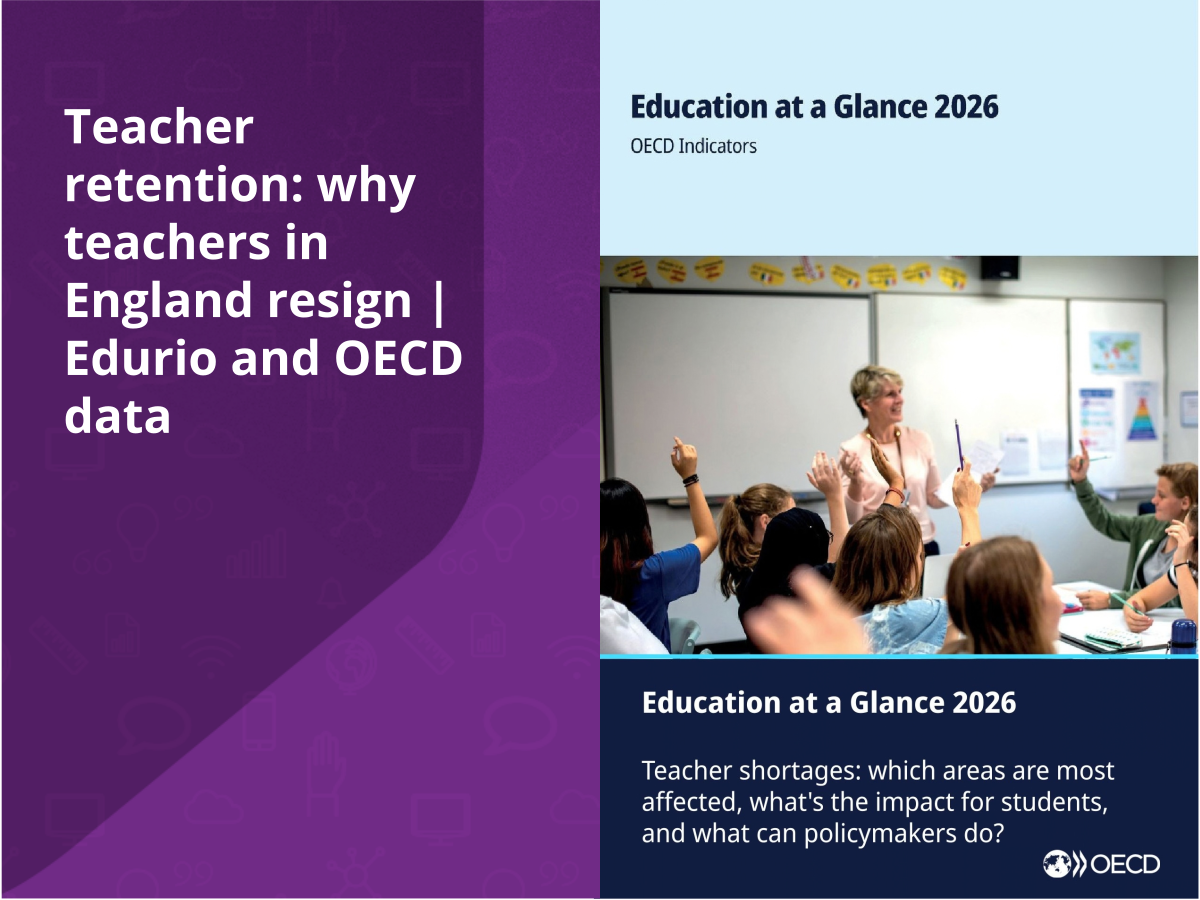
6 October, 2026
•
New OECD figures show teachers in England resign 70% more often than the international average. Our data from 110,673 school staff shows why they leave, what keeps them, and what school and trust leaders can do about it.
Read more