 Share
Share  Share
Share  Share
Share The support staff workforce deserves the same attention as the teaching workforce. Support staff make up more than half of the school workforce in England, yet their experience is too often missing from the national conversation about school workforce planning, recruitment and retention.
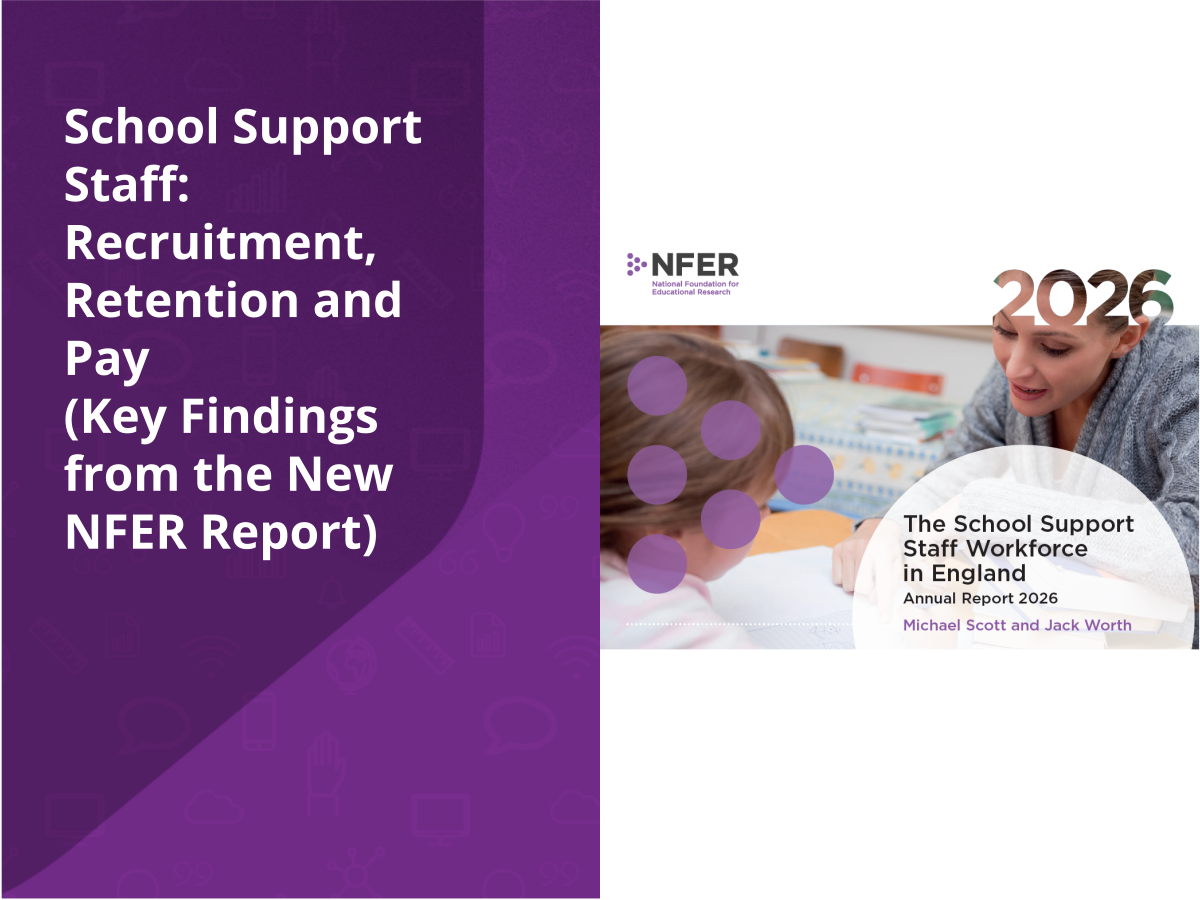
A new report from the National Foundation for Educational Research (NFER), funded by the Nuffield Foundation, helps close that gap by putting a sharper focus on what is happening for school support staff, including teaching assistants.

The report combines national workforce and labour market evidence with views from school leaders. Crucially, it also includes support staff voices, drawn from Edurio staff survey responses that NFER used as part of the analysis. That matters because the numbers only tell part of the story.
This is the first annual report in a new series focused on support staff. It lands at a time when many leaders are juggling tighter budgets, rising needs and persistent recruitment challenges. Support staff are central to how schools function, how pupils are supported and how inclusive practice is delivered day to day. When this workforce is stretched, the impact is felt everywhere.
In this post, we summarise:
- What the report adds to the national workforce conversation
- Key findings on support staff growth, teaching assistant recruitment and retention
- What support staff say about pay, workload, morale and feeling valued
- NFER’s recommendations for schools, trusts and the wider system
Below are a few highlights from the report, why they are useful for school and trust leaders and the recommendations NFER makes for the system.
What the NFER report adds to the school support staff workforce
NFER’s approach is useful because it brings multiple lenses together:
- Workforce trends (support staff numbers and retention) using the School Workforce Census
- Pay and working conditions using national labour market datasets
- School leaders’ views on how difficult recruitment feels in practice
- Support staff perspectives, including Edurio survey data, to show what these trends look like in real working lives
That combination matters. Workforce planning is not just about headcount. It is about whether people can be recruited, whether they stay and whether their work feels sustainable and recognised.
Key findings: support staff recruitment, retention and pay
Support staff workforce growth is driven by teaching assistants
The report finds that the support staff workforce continues to grow year on year, and that most recent growth is driven by teaching assistant roles. Growth is particularly strong in secondary and special schools. In primary schools, support staff numbers are largely flat. That is notable in the context of falling pupil numbers and teacher numbers in primary.
For you as a leader, this matters because staffing models are shifting. The mix of roles and where growth is concentrated has implications for capacity, supervision, training and the support available to pupils with additional needs.
Teaching assistants support SEND — but also wider learning and inclusion
NFER finds evidence that variation in SEND needs may be linked to demand for teaching assistants, but the relationship is not especially strong. A 2023 survey suggests SEND support is a common part of teaching assistants’ work, but general learning support is even more common.
This is a useful reminder that teaching assistants are doing complex, wide-ranging work. Many are supporting learning across the classroom, not only specific pupils. When you plan capacity, the role often sits at the centre of inclusion, learning support, behaviour and wellbeing.
Teaching assistant recruitment remains difficult for most school leaders
Despite some improvement since 2023, around three in four school leaders reported that they found it difficult to recruit teaching assistants in 2025. Leaders reported greater difficulty recruiting teaching assistants than teachers. The report also notes that the Department for Education does not systematically collect data on teaching assistant shortages.
This is not just a staffing headache. If you cannot recruit the people who make everyday support possible, pressure rises elsewhere. Teachers carry more, pupils wait longer for help and specialist support becomes harder to sustain.
Support staff retention is worsening, with higher exit rates
NFER’s experimental analysis suggests just under one in five support staff left the state school system within 12 months in the latest data, with exit rates rising in each of the last three years.
Even where recruitment is working, churn can undermine continuity and relationships. That continuity is particularly important for pupils who rely on predictable, trusted adults.
What support staff say: feeling valued, workload and morale
The report draws on Edurio staff survey data to shed light on why people consider leaving. Many respondents cite not feeling valued and low morale. Staffing shortages, financial reasons and workload are also commonly mentioned.
This is the point where workforce policy becomes culture, leadership and day-to-day working conditions. Feeling valued is not a “nice to have”. It is part of whether someone can picture a future in the role.
Support staff pay remains uncompetitive compared to similar roles
NFER finds that support staff earn less than workers with similar characteristics, and the report discusses how working patterns and hours shape this gap. The report also notes that a significant proportion of support staff in the Edurio survey data rate their pay as not fair compared to similar roles in their organisation.
Pay is not the only factor, but it is foundational. If the labour market offers better-paid options with more flexibility, schools are competing in a tough environment.
What this means for school and MAT leaders
There is a risk that support staff are treated as a secondary workforce, even while the system increasingly depends on them. The report paints a picture of rising demand and ongoing recruitment difficulty, alongside a retention challenge that is becoming more pronounced.
Two implications stand out for workforce strategy and your recruitment and retention strategy:
- Support staff strategy needs to be deliberate. If teaching assistant roles are expanding, particularly in secondary and special, you need a serious approach to training, development and progression.
- Experience is an asset schools cannot afford to lose. When the report points to feeling undervalued and low morale as common reasons for considering leaving, that is a leadership signal. It suggests retention is partly about conditions you can influence locally, even when budgets are tight.
NFER recommendations: recruitment, training, pay and progression
NFER’s recommendations focus on five practical areas:
- Recruitment and training for support staff (especially teaching assistants): Do more to help schools recruit support staff, especially teaching assistants, and strengthen training, including for SEND-related skills.
- Feeling valued and recognition (linked to retention risk): Schools should take practical steps to help support staff feel valued, because this is closely linked to people thinking about leaving.
- Support staff pay competitiveness: Review whether low pay is contributing to recruitment and retention problems, particularly for teaching assistant roles.
- Career pathways and progression for support staff: Improve career pathways and progression opportunities for support staff.
- Better national data on vacancies and retention: Improve national data, including vacancy data for support staff and clearer tracking of retention and trust central roles.
Taken together, the recommendations point to a simple message: support staff are essential to school capacity and inclusion, but the system is not set up to recruit and keep them consistently. NFER calls for a joined-up response that improves training and progression, tackles pay competitiveness and strengthens everyday experiences of being valued. Backed by better national data, that combination would help you plan with more confidence, reduce churn and protect the continuity pupils rely on.
What Edurio learns: staff voice, morale and intention to leave
It is encouraging to see support staff voice included in a national workforce report. The findings also reinforce something you may recognise from your own context: people stay where they feel seen, respected and able to do their work well.
If you are a school or trust leader, this report is a prompt to look at support staff experience with the same seriousness you bring to teacher retention. Not because it is fashionable, but because it is fundamental to stability, inclusion and improvement.
Support staff experience
Understand how support staff experience compares across your schools and what is driving intention to stay or leave
Explore how Edurio can help you benchmark staff survey results, identify retention drivers, and track change over time.
