 Share
Share  Share
Share  Share
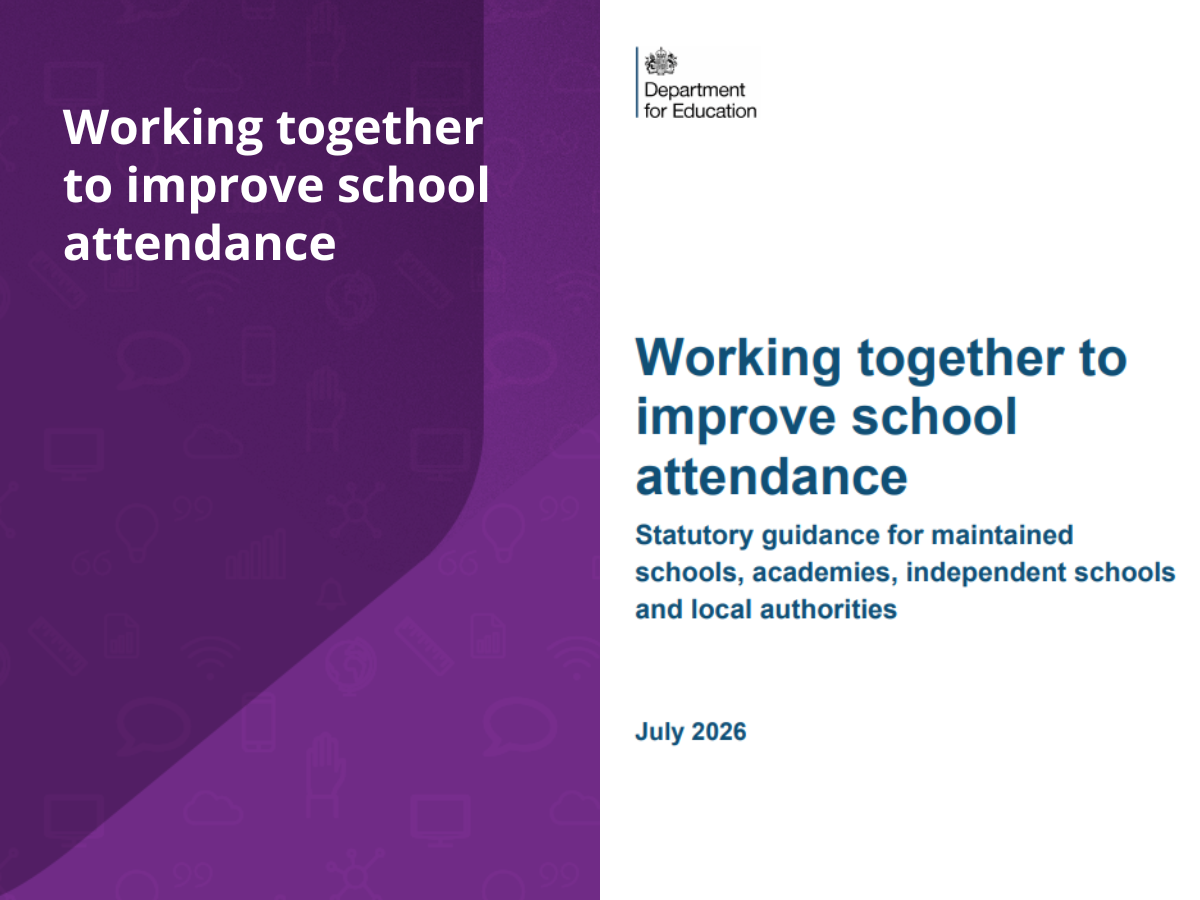
Share In July 2026, the Department for Education published an updated edition of Working together to improve school attendance, the statutory guidance for maintained schools, academies, independent schools and local authorities. It replaces the August 2024 edition, which was the last substantive version. The July 2026 edition applies to the same audience as before: school and trust staff, governors and trustees, local authority attendance teams, virtual school heads and statutory safeguarding partners.
Unlike the 2024 edition, which was published several months ahead of its 19 August start date, this one carries no separate application date in the text, so schools and trusts should treat it as being in effect now. DfE describes the changes as clarifications made in response to sector feedback, and that’s a fair description. There’s no new statutory framework here. But one change is a genuine new “must”, and a further run of should-level refinements touch on some of the areas schools have found hardest to apply consistently since 2024: blanket policies, medical evidence, remote education and the split of responsibility between schools and local authorities.
Every change in this update needs to be acted on. This section only covers what’s most likely to require a change to process or paperwork.
Take the attendance register at the same time for all pupils, in both sessions
The clearest new requirement in this edition sits in paragraph 32 (chapter 2) and is repeated in paragraph 290 (chapter 8): schools must take the attendance register at the same time for all registered pupils, in both the morning and the single required afternoon session. The 2024 edition required registers to be taken at the start of each morning session and once each afternoon, but said nothing about pupils being registered at different times within that session.
For schools whose management information system allows staggered registration, for example where form tutors take the register as pupils arrive at a lesson rather than at one fixed point, this requires a real change in practice. Check your MIS configuration and any staggered start arrangements against it before the new term. It’s one of the few points in this update that DfE has framed as an outright duty rather than a recommendation.
Secondary changes worth planning for
No blanket policies on leave of absence for exceptional circumstances
Paragraph 36 (chapter 2) adds a new line to the existing “exceptional circumstances” leave of absence category: schools should consider each application on its individual merits and should not operate blanket policies under which leave is granted automatically in response to particular circumstances or events. The 2024 edition set out the same category without this caveat. Any school with a standing policy of automatically granting (or automatically refusing) leave for a defined set of circumstances, a funeral within a certain family relationship, for example, should re-read this section and check its policy still reflects individual consideration.
Medical evidence: less about doubt, more about understanding
Two related changes sit in paragraphs 62 (chapter 2) and 374 to 375 (chapter 8). The 2024 edition said schools should only request medical evidence where they had “genuine and reasonable doubt about the authenticity” of an illness. The July 2026 edition keeps that principle but broadens the legitimate reasons for requesting evidence to include supporting pupils with health needs that are “complex, long-term or frequently recurring,” and adds an explicit line that schools should not have blanket rules requiring medical evidence for illness absence. In practice, this shifts the emphasis from suspicion to understanding. Schools can now request evidence to help support a pupil with an ongoing health need, rather than only to test a parent’s claim. Blanket, routine demands for a doctor’s note remain off the table either way.
Remote education is now explicitly a last resort
Paragraph 293 (chapter 8) adds a cross-reference to DfE’s separate guidance on providing remote education, stating that remote education for an absent pupil should only be used as a last resort, once reasonable adjustments have been considered, and as part of a wider plan to support the pupil’s return to school. The 2024 edition simply noted that pupils receiving remote education still need to be marked absent using the correct code. Any school using remote lessons as a routine response to prolonged absence, rather than a temporary step towards a full return to the classroom, should revisit that practice against this wording.
Young carers get their own section
Paragraph 53 (chapter 2) introduces a dedicated subsection on pupils who are young carers, absent from the 2024 edition beyond a single passing mention. It restates that young carers must be recorded in the school census, and it sets an expectation that schools work in partnership with the pupil and family to understand caring-related barriers to attendance. Where needs go beyond the school gates, it points schools towards local early help arrangements and, where appropriate, a local authority young carer’s needs assessment under section 17ZA of the Children Act 1989.
Local authorities’ role reframed around strategic leadership
Paragraphs 85 to 88 (chapter 4) rewrite the introduction to local authorities’ role. The 2024 edition described local authorities mainly as facilitators of support for individual families. The 2026 edition leads instead with local authorities as “strategic leaders across a geographical area,” adds a new paragraph on the complementary roles of schools, trusts and local authorities, and is more explicit that both universal practice and individual casework sit within a single system-wide approach. It’s a change of framing rather than duties, but it’s a useful steer for any trust negotiating the shape of its local authority’s attendance offer.
The rest of the changes, in brief
- Flexi-schooling gets its own explanatory subsection for the first time (paragraph 360, chapter 8), clarifying that schools aren’t obliged to offer it and that it is distinct from a part-time timetable.
- DfE has added a new definition of “no fixed abode” for Code T, parent travelling for occupational purposes (paragraph 362, chapter 8).
- Code Q now also covers local authorities that are in the process of arranging home-to-school travel but haven’t yet completed it, alongside those that have failed to arrange it at all (paragraph 380, chapter 8).
- DfE has set out the expectations on analysing and monitoring attendance data in more detail, including explicit benchmarking against local, regional and national levels and a wider list of cohorts to track (paragraph 44, chapter 2).
- A handful of legal and technical points have been tidied up, including wording around the admission register, the “reasonable distance” test under Ground G for deleting a pupil’s name, and references to reasonable adjustments (chapters 7 and 8). None of these change the underlying test.
Where each change sits in the guidance
| Change | Where it sits (July 2026 edition) | Types of action |
| Registers taken at the same time for all pupils | Chapter 2 para 32; Chapter 8 para 290 | Must |
| No blanket leave of absence policies for exceptional circumstances | Chapter 2 para 36 | Should |
| Medical evidence: no blanket rules, broader legitimate grounds | Chapter 2 para 62; Chapter 8 paras 374 to 375 | Should |
| Remote education as last resort, part of a reintegration plan | Chapter 8 para 293 | Should |
| Young carers subsection | Chapter 2 para 53 | Should |
| Local authorities as strategic leaders | Chapter 4 paras 85 to 88 | Framing, no new duty |
| Flexi-schooling explanatory subsection | Chapter 8 para 360 | Clarification |
| “No fixed abode” definition (Code T) | Chapter 8 para 362 | Clarification |
| Code Q covers travel arrangements in progress | Chapter 8 para 380 | Clarification |
| Expanded benchmarking and monitoring expectations | Chapter 2 para 44 | Should |
| Admission register and Ground G technical wording | Chapters 7 and 8 | Clarification |
Why this matters for leaders
None of these changes are individually dramatic, but together they raise the bar on how consistently attendance policy is applied. That consistency is what shows up in Ofsted’s evidence base and in local authority scrutiny of persistent and severe absence. A blanket leave policy or a standing requirement for medical evidence looks reasonable in the staffroom, until it’s tested against this guidance during an inspection or a legal challenge. This edition removes any ambiguity about where DfE stands on both.
The stakes are also set nationally. The government’s Every Child Achieving and Thriving schools white paper, published earlier in 2026, commits to lifting the overall attendance rate by 1.3 percentage points to over 94% by the 2028 to 2029 academic year, equivalent to 20 million more school days a year and, DfE says, the fastest rate of improvement in a decade. Attendance guidance changes of this kind are the operational detail behind that target, and the trusts that treat them as routine housekeeping now will be better placed when scrutiny of that target increases.
Practical steps
- Check whether your MIS or staggered registration arrangements allow pupils to be marked at different times within a session, and correct this ahead of the new term.
- Review any written or informal blanket policy on leave of absence for exceptional circumstances, and confirm decisions are being made on individual merit.
- Review your policy and staff guidance on requesting medical evidence for illness absence. Remove any blanket requirement and check it reflects the broader legitimate grounds set out in paragraphs 62 and 374 to 375.
- Check how remote education is used for pupils with prolonged absence, and confirm it sits within a documented plan for reintegration rather than as a standing alternative to attendance.
- Update safeguarding and pastoral staff training to reflect the new young carers subsection, including the referral route to a local authority needs assessment.
- Brief governors and trustees on the reframed local authority role ahead of any joint attendance strategy discussions this term.
How Edurio can help
Several of these changes, on leave of absence, medical evidence and young carers among them, are hard to monitor from data alone. They depend on how consistently policy is applied in practice and how supported families feel by it. Edurio’s Pupil Attendance Survey gathers staff, pupil and parent views side by side. It gives trusts a way to check whether attendance policy is landing as intended, beyond the raw attendance figures.
See the Pupil Attendance Survey