 Share
Share  Share
Share  Share
Share This article was originally published in Schools Week. You can read the original version on Schools Week here.
Middle leadership was never meant to carry this much weight. Yet in many schools, it has quietly become the role where accountability, implementation and pastoral responsibility collide, often without the time, authority or protection to match.
Recent national staff experience data suggests this is not just a feeling. It is showing up clearly and consistently in how middle leaders are experiencing their work.
Analysis of Edurio’s national Staff Experience Survey from the 2024/25 academic year, drawing on responses from more than 85,000 school staff in England, reveals a stark pattern. When asked, “Overall, how well have you felt lately, physically and mentally?”, positive responses were:
- Senior leaders: 60 per cent
- Administrative staff: 46 per cent
- Teaching assistants: 38 per cent
- Teachers: 35 per cent
- Middle leaders: 34 per cent

Middle leaders report the lowest wellbeing in schools
Middle leaders report the lowest wellbeing of any group in schools. Lower than classroom teachers and far lower than senior leaders. That surprised me most.
The wider context matters. Schools are operating under sustained and compounding pressure, shaped by the legacy of Covid, ongoing funding constraints, workforce shortages and relentless policy change. Middle leaders are where much of this pressure lands.
As academic and author Alexander Nachaj notes, “Middle leaders often carry pressure from both sides and it shows here.”
Department leads, heads of year and phase leaders are expected to implement reform, manage people, raise outcomes, support staff wellbeing and continue teaching, often without additional time, authority or structural protection.
This pressure is not accidental. As instructional leader and coach, Cat Stephens observes, “Middle leaders absorbing all the pressure is usually an indication that senior leaders don’t have the balance right between being on the balcony and getting onto the dancefloor.”
The data backs this up.
Middle leaders are more likely than any other group to feel stressed frequently.
A majority report feeling stressed very or quite often, with far fewer saying they rarely or never feel stressed. This places middle leaders below senior leaders and broadly in line with, or worse than, classroom teachers, despite their additional responsibilities.

Workload pressure follows the same pattern.
Middle leaders are among the most likely to say they feel overworked often, reflecting the reality of holding significant leadership responsibility alongside a full or near-full teaching load. Very few report feeling overworked rarely or never.

High commitment, low wellbeing
What makes this picture particularly uncomfortable is that middle leaders are not disengaged.
Sixty-one per cent say they feel excited by their work, and 51 per cent say they feel appreciated by leadership. Both figures are higher than for classroom teachers. And yet only 34 per cent report feeling physically and mentally well.
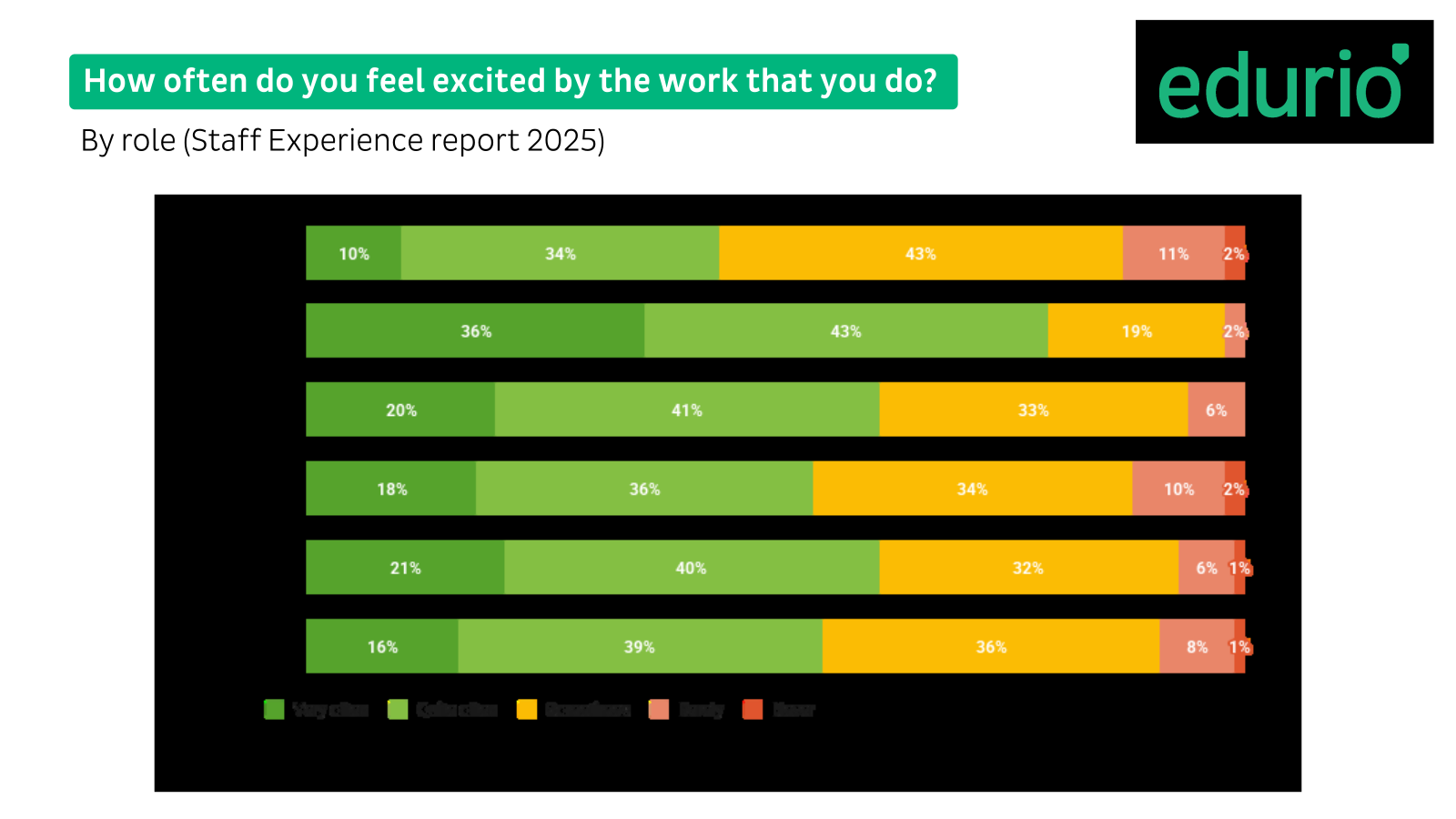
This gap suggests middle leaders are not struggling because they lack commitment or ambition. They are struggling because the role itself is overloaded.
Headteacher Tom Kennedy Fowler points to workload as a key factor, noting that the similarity between teacher and middle leader responses is “indicative of the pressures of a full or almost full teaching load”.
It is also hard to ignore how closely middle leaders’ wellbeing mirrors that of classroom teachers. Both groups often carry full or near full teaching timetables, with limited control over their time. Senior leaders may face intense strategic pressure, but they typically have greater autonomy and headspace to manage it.
These findings are not unique to schools in England. They reflect a broader global pattern in which the middle layer consistently reports poorer wellbeing than both senior leaders and those they manage. Gallup’s State of the Global Workplace 2025 report shows that declining engagement and wellbeing among managers is the primary driver of falling engagement worldwide, and is explicit that improving engagement starts with the middle layer, through better role design, training and ongoing support for managers.
Improving retention, unevenly
There is some good news. For the first time since the pandemic, overall resignation risk has fallen slightly, and middle leaders are less likely to be considering leaving than last year.
However, 45 per cent report having considered resigning in the past three months, only slightly lower than teachers at 46 per cent, compared to 28 per cent of senior leaders. Their most common reasons are overwhelming workload, poor work-life balance and feeling undervalued. They are also more likely than other roles to cite dissatisfaction with senior leadership and government policy.

As diocesan schools commissioner Michael Merrick cautions, differences between roles may also reflect selection effects, with senior leadership roles more likely to be occupied by those better able to manage mental load and anxiety. That does not reduce the significance of the gap, but it does underline how demanding middle leadership has become.
This matters for more than wellbeing. Middle leaders are the engine room of school improvement and the future supply of senior leaders. If the role is experienced as a prolonged period of unsustainable strain, fewer people will step up. More will step sideways. Some will leave altogether.
What changes when support is designed in
Where organisations treat middle leadership development as a strategic investment rather than a perk, the impact can be significant. At Temple Learning Academy, middle leadership development is approached deliberately and systemically. A structured programme combines leadership training, internal professional development and external learning opportunities. This programme certainly seems to be having an impact on workload, as the school scored highly against national benchmarks for managing workload. Headteacher, Stuart Huddleston, explains:
Middle leaders are the tip of the spear. They’re driving school improvement forward. They are the ones on the ground, they’re the ones working with their teams, they’re the engine room, they’re the drivers. So, it’s well worth that investment in them and for them.
So the most important question this data raises is not whether middle leaders are struggling. The better question is who owns the design of roles that remain sustainable under sustained pressure, and what we can learn from the places already getting it right.
Because if we want schools that can thrive, not just cope, middle leadership has to be supported by design, not sustained by endurance alone.