Recruitment and Retention in School Trusts: Lessons From People Power 2026
Reflections from Iona Kelliher, Managing Director, Edurio
 Share
Share  Share
Share  Share
Share I will happily admit that People Power is one of my favourite events of the year. I am not sure many people have a favourite webinar, but I do, and this is it.
On 30 June 2026 we spent a morning with HR leaders and trusts from across England, working through four stages of the staff experience: attracting, engaging, developing and retaining people. More than 150 leaders signed up to be part of the day for the fourth running of this event. I chaired the day, and as ever I came away having learnt as much as anyone.
One thread ran through every session.
One gap, running through everything
Throughout the day, I was reminded just how important it is that we close the gap between our perceptions as senior leaders and those of the wider staff body. Experiences differ greatly between different people, with clear trends by role and other groupings, but fundamentally a trust is an organisation made up of individual human beings working towards a shared goal. The more we understand each other, the more we can move forward with a sense of collective purpose: the purpose of providing a great education.
As an important example of these differences, our national data shows senior leaders are consistently the most positive group. One of the starkest examples is in feedback: 80% of senior leaders say their voice has an impact, but only 29% of teachers say the same.
As my colleague Imanta explained, the closer you sit to decision-making, the more visible the link between your voice and what happens next, so this is a structural problem rather than a lack of intent. The question for all of us is how to make that line visible for the people furthest from the room where decisions get made.
Attracting staff: tell the truth, and tell it well

The day opened with attracting staff, and Ben set the scene with the national picture based on our latest Edurio survey national data: the “value proposition” of the sector as a whole. Staff experience improved in six of 13 Edurio survey topics last year, but it worsened in pay and benefits, in staff support and relationships, and in career opportunities.
The headline here was that a single employer brand will not resonate equally with every role. Teachers remain the least positive group, though there are signs of green shoots with improvements compared to last year. Dishearteningly, only 38% of teaching assistants told us they feel physically and mentally well, and admin staff are the least likely of any group to feel excited about their work.
Helen Kitchen from Talent Architects built her session around an old Bananarama lyric, reminding us that it isn’t enough to think about what you do, but it is the way you do it, the time you do it and the place you do it. Her point was that peer stories beat institutional messaging, that your employer brand should be always-on rather than switched on only when a vacancy appears, and that most school staff live within 10 miles of where they work, so the local community is a vital recruitment channel we should not overlook.
Clair Jenkins from Greenheart Learning Partnership then told us how this works in practice. She made it clear that the first phone call is the most important moment in the process, and that she takes it herself every time. Greenheart keeps a close eye on the experience of staff once they’re in post too, linking this clearly with their recruitment strategy. By understanding how things feel for their staff in post, she can speak confidently about where they are as an organisation right now and – crucially – identify what they’re not comfortable settling for. This feeds into their school improvement strategies, meaning that the overall employer value proposition – the thing that they can shout about to potential hires – continues to strengthen over time.
Engaging staff: what happens after the survey
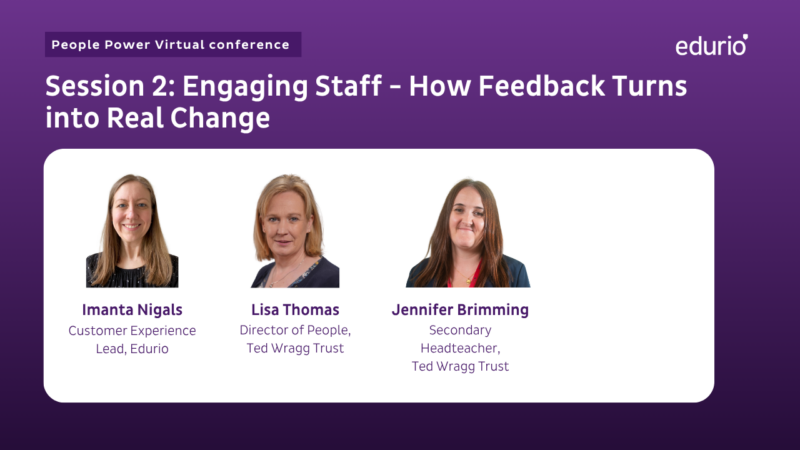
Our second session was about turning feedback into change, something we think about constantly at Edurio. Imanta introduced our listening framework, built on four practices: voice, understanding, action and communication, alongside four mindsets that stop the practices from feeling like a tick-box exercise.
Jen Brimming, head of Marine Academy Secondary in the Ted Wragg Trust, described what she calls “ear to the rail” leadership. Most of her senior team do not have offices, by design, so they are out with staff all day. When the school made a major change to the classroom setups this year, her team ran a live snagging list and met every morning to act on it, often the same day, so something as small as teachers losing their whiteboard pens was fixed immediately.
She was also honest about getting it wrong. When one change made behaviour worse, she stood up in front of all her staff and apologised, and as she said, that vulnerability builds as much trust as getting it right.
Lisa Thomas spoke from the trust perspective at Ted Wragg, where, as Director of People, survey completion has climbed from 54% in their first year to 89% this year. Her guiding principle was that data should start the conversation rather than end it. Their workload results have stayed stubbornly static despite sitting above the national benchmark, so instead of accepting the number, they are now preparing to run listening sessions in every school in the upcoming academic year, led by Lisa and their chief executive.
Developing staff: a trust dividend we cannot take for granted
Career opportunity is one of the topics moving in the wrong direction nationally, which should worry all of us in the trust sector. Support staff feel this most sharply: close to 40% of teaching assistants cite a lack of career progression as a reason they would consider leaving.
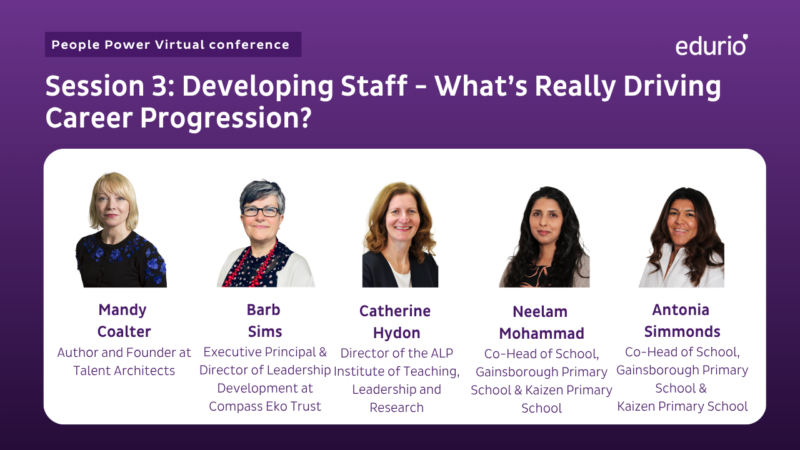
Mandy Coalter from Talent Architects called career pathways and CPD the “trust dividend”, the thing staff most often say they value about being part of a trust. Her observation about middle leaders also rang true: they are often blocked from senior roles not by a gap in education expertise, but by a gap in people management.
The teams from Compass Eko Trust showed what intentional development looks like: weekly or fortnightly one-to-ones for every staff group, including teaching assistants, a shared language of “blockers” in those conversations, and CPD mapped for every person at the start of the year. In one school, they extended support staff hours so those colleagues could be part of the CPD offer, and the difference in their sense of belonging was visible.
Catherine Hydon described the institute that Advance Learning Partnership launched last September, with optional training that staff can book onto. Since then, they have run 186 professional learning opportunities, filled more than 1,800 places, and involved over 70 staff in leading training. Their secret was simple: consult heads early, and protect those evening slots.
Belonging and retention: the knock on the door
The final session turned to retention, and the data made the case for why we elevated belonging in this conversation. 41% of staff were at risk of resignation last year, down from 43%, but still high, and the drivers of leaving are overwhelmingly cultural and within a trust’s control: feeling undervalued, workload and low morale.
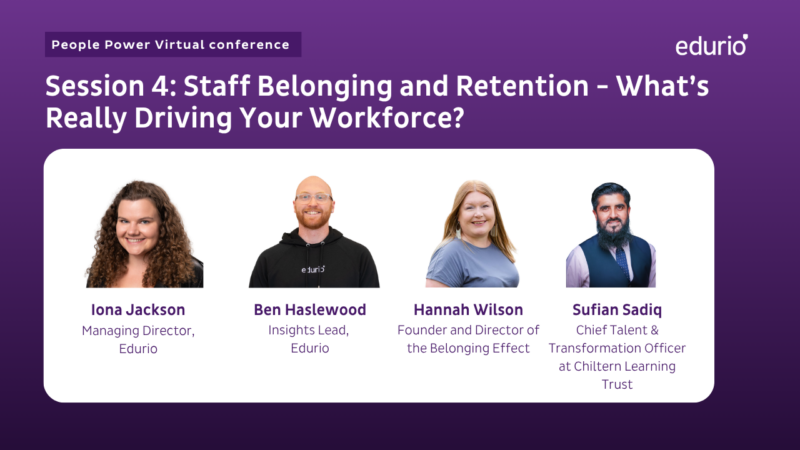
Sufian Sadiq from Chiltern Learning Trust showed what is possible. Their survey revealed that perks and discount schemes were not what staff wanted; what mattered was the quality of line management, so they built a human-centred leadership programme for everyone who manages anyone. As Sufian put it, an NPQ will not teach you that it helps to know the names of your team’s children, and he told the story of a teacher who left an outstanding school because a head would not let them take time off to look after a sick pet. What matters to people varies from person to person.
Chiltern recruited 375 teachers without spending a penny on advertising, by turning up in the community, at mosques, churches, carol services and canal clean-ups. In one school, 43 supply teachers were replaced by local, permanent staff. As Sufian said, the knock on the door matters more than the school improvement document.
Hannah Wilson of The Belonging Effect encouraged us to look more closely at our own data and delve deeper through intersectional lenses, as we do with pupil data. She made a strong case that line manager training is the single most effective investment a trust can make, that exit interviews come far too late, and that even our social events can be exclusionary. The Christmas party, she pointed out, can be a barrier on grounds of alcohol, cost or religion, and she asked us to think about the phrase “non-teaching staff”. They are support staff, operational staff, and colleagues.
What I am taking away
Four things I am taking away.
First, kind leadership is about clarity: as the teams from Compass/Eko put it, being kind and being clear are the same thing, and it is a lens I want to bring to my own practice.
Second, belonging and the quality of line management drive retention far more than pay or perks, which is both a challenge and an opportunity given how much of it is within our gift. It’s a straightforward solution in theory and a difficult-to-get-right one in practice.
Third, as Lisa Thomas said, data should start the conversation rather than end it, and the best practitioners in the room used the results from staff voice exercises to open up forums, one-to-ones and community conversations.
And finally, tailoring matters: one employer brand, one CPD offer and one approach will never fit every role. The more we understand the perspectives of different people, and different groups of people, the more we can build that sense of shared purpose.
Thank you to every speaker who gave their time and to everyone who spent their morning with us. Everyone who registered will receive the recordings of all four sessions, and I am already looking forward to doing it all again next year.
Read our latest staff experience report for the full national picture behind these reflections.
Save your seat for 2027 →