
 Share
Share  Share
Share  Share
Share Staff retention in schools has been consistently challenging for years. Still, Edurio’s Staff Experience Report 2025 offers a crucial reality check for Trust and School leaders: the tide is turning, but not uniformly. With over 85,000 school staff completing an Edurio staff experience survey in the 2024/2025 academic year, our national dataset is a robust benchmarking tool for schools and trusts.
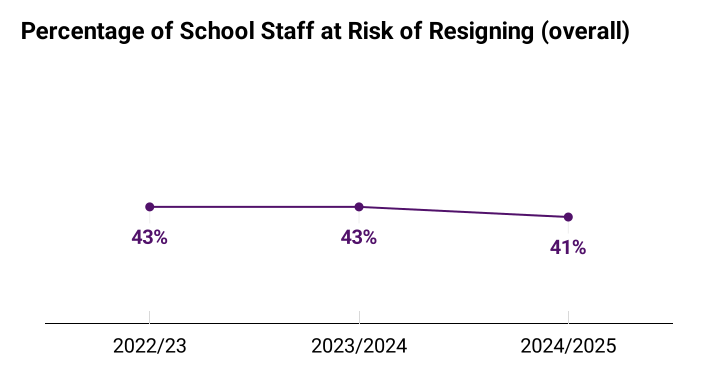
We’re seeing an overall improvement, with the proportion of staff considering resignation dropping to 41% in 2024/25, down from 43% in the previous two years. This could be a sign that previous retention efforts may finally be bearing fruit.
However, a closer look at the data reveals sharp role-based differences that demand a nuanced strategy.
The Role-Based Retention Picture
While the overall trend is positive, progress is heavily concentrated in specific roles, highlighting who is benefiting from organisational changes and who is being left behind.
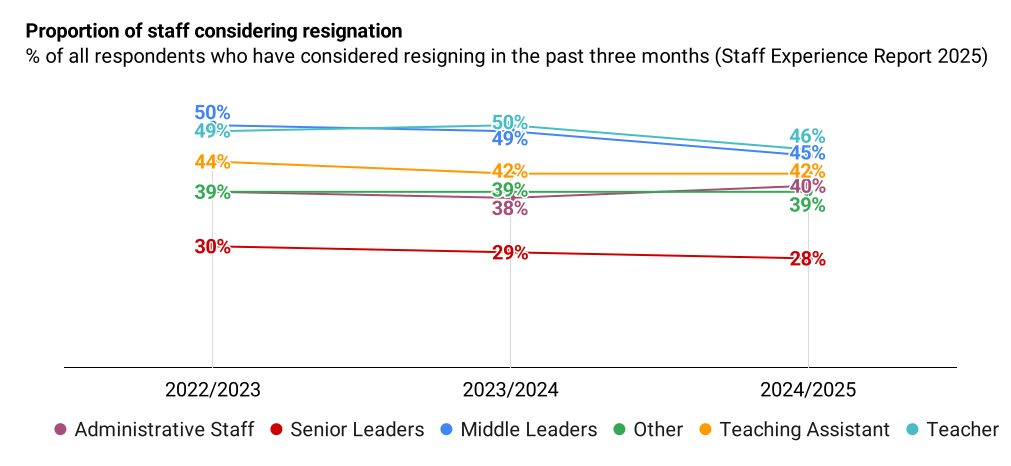
- Teachers still report the least positive experiences, but their resignation risk has fallen from “about half” to 46% in 2024/25. This narrowing of the gap with other colleagues is encouraging.
- Middle Leaders have seen the sharpest improvement, moving from 49% considering resignation to 45%. This group has historically been at high risk, making this decrease particularly encouraging.
- Senior Leaders remain the group least likely to resign, with only 28% considering it in 2024/25.
- Administrative Staff are the sole group where resignation risk increased, rising from 38% to 40%. For Trust Leaders, this group is now a critical area of focus, as they are also the group least excited about their work.
- Teaching Assistants saw their resignation risk hold steady at 42% in 2024/25, having decreased from 44% two years ago. However, leaders should note this group remains below the national average for feeling appreciated by leadership and for overall wellbeing.
- Staff in Other Roles (including a wide variety of support positions) maintained a consistent risk of resignation at 39% for the third consecutive year, suggesting stability in this diverse segment of the workforce.
Pinpoint Your Priorities
National data provides the backdrop, but retention is won or lost at the trust and school level. The fact that overall staff sentiment is improving, yet one group (Administrative Staff) is moving backwards, highlights the danger of a one-size-fits-all approach.
To capitalise on the positive national momentum and address your internal pain points, you need granular, local insight. Is your administrative staff’s dissatisfaction driven by a lack of career progression (a unique issue cited by this group), or is it an entirely different localised factor?
The best way to confidently address barriers and replicate successes is to ask your staff. Edurio’s Staff Experience Survey is designed to provide the specific, actionable data you need, allowing you to prioritise practical steps that maximise impact for your most valuable resource: your people.
To make these national figures more meaningful locally, try our new Risk of Resignation Calculator. It uses national benchmark data to estimate what the current level of resignation risk could mean for a school or trust of your size. In a few steps, you can translate percentages into an estimate of the number of colleagues who may be considering leaving, giving you a clearer sense of scale and urgency. Use it as a starting point for planning. Then validate the picture with your own staff voice data so you can focus action where it will make the biggest difference.
Become a Listening Organisation
Encourage your organisation to become a ‘Listening Organisation’ today by running a Staff Experience Survey and translating these trends into confident, local action.