
 Share
Share  Share
Share  Share
Share When a teacher leaves, the cost is rarely just a vacancy. It shows up in recruitment fees, supply spend, leadership time spent firefighting, and added pressure on the staff who remain.
The problem is that most schools only feel the full impact once a resignation has already happened. By then, the disruption, and much of the cost, is already unavoidable.
A more useful question is what happens earlier: what makes staff more likely to leave, and what can schools do before dissatisfaction turns into attrition?
What does the national data say?
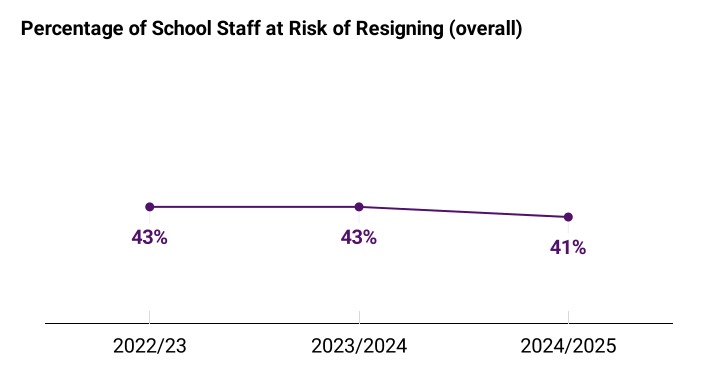
Our latest national Staff Experience Report suggests the warning signs remain widespread. In 2024/25, 41% of staff said they had considered resigning sometimes, often or constantly in the previous three months. That is the first improvement since the pandemic, down from 43% in each of the previous two years, but it is still a substantial share of the workforce. The main reasons have remained strikingly consistent: feeling undervalued, overwhelming workload and low morale in the workplace.
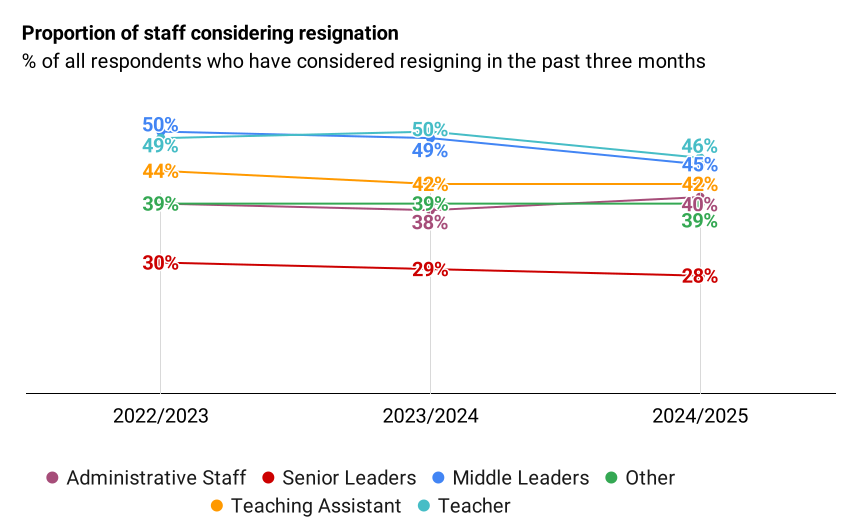
Among teachers specifically, 46% were still at risk of resignation in 2024/25, even after some improvement from the year before.
This matters because the wider labour market for schools is still under pressure, even if the latest picture is more positive than it was a year ago. NFER’s The School Teacher Labour Market in England Annual Report 2026 says the latest data shows significant signs of improvement in recruitment and retention, with gains that may ease some of the effects of poor teacher supply over the last decade. Recruitment to initial teacher training improved in 2025/26 and appears to be holding up into 2026/27. Teacher retention has improved modestly, and teachers are more positive about workload than they were four years ago. But NFER is also clear that this is not a time for complacency: secondary recruitment remains below target, and recent progress could still be reversed.
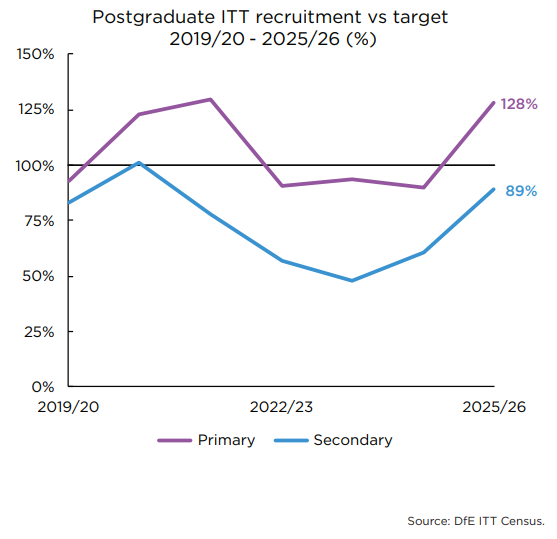
The shift is visible in the recruitment data. In 2025/26, secondary postgraduate ITT recruitment reached 89% of target, up sharply from the previous year, while primary recruitment exceeded target with around 9,800 recruits against a target of 7,700. Early data for 2026/27 is also encouraging, although NFER still forecasts overall secondary recruitment to remain below target.
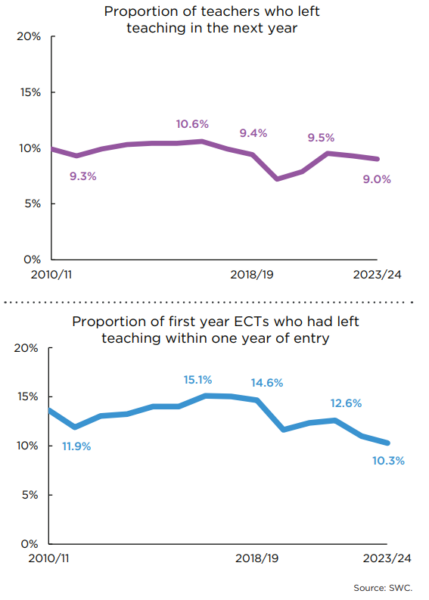
Retention has improved too. NFER reports that 9% of teachers left the state school system between 2023/24 and 2024/25, a slightly better rate than in the previous two years. The exit rate for first-year early career teachers fell to 10.3%, the lowest on record. NFER also highlights job satisfaction, leadership support, pupil behaviour, pay satisfaction and workload as significant factors associated with teacher retention.
Even so, the pressure on schools has not disappeared. Vacancy rates remain elevated by historical standards, even though they have eased slightly. NFER reports that the vacancy rate rose from two vacancies per 1,000 teachers in 2019/20 to six in 2023/24, before falling back to five in 2024/25. In Autumn 2025, 71% of secondary leaders and 49% of primary leaders said recruiting teachers was difficult.
There are also signs of how these pressures show up in day-to-day school life. NFER reports that the average secondary pupil-teacher ratio rose from 14.9 in 2014/15 to 16.7 in 2024/25, and that the proportion of pupils in classes of more than 30 rose from 10.3% in 2015/16 to 16.3% in 2024/25. Those are not just sector-level trends. They are signs of the strain schools face when staffing becomes harder to secure and harder to stabilise.
What is the real cost of teacher turnover?
There are also direct costs that schools and trusts can see on their budgets. In December 2025, the Department for Education said schools had spent £1.4 billion on agency staff in 2023/24 as it launched a new programme to cap excessive mark-ups. And even when a school finds someone good through supply, converting that arrangement into a permanent appointment can be expensive. A Tes article on finder’s fees reported that schools can be charged up to 20% of salary, with fees reaching around £10,000 in some cases.
King’s Leadership Academy Liverpool offers a useful example of what early listening can make possible. By using regular staff feedback to identify issues and act on them, the school improved retention and reduced its reliance on supply teachers, saving around £240,000 in supply costs in one year. Leaders also reported wider benefits from a more stable staff team, including more consistent behaviour, stronger relationships and fewer sickness absences.
Taken together, that creates a strong case for seeing resignation risk as more than a staff wellbeing metric. It is also an indicator of future cost pressure.
Why resignation risk matters
How many of your staff could be at risk of leaving?
Use our Staff at Risk Calculator to get an estimate based on national benchmarks and see the potential impact on your staffing.
That does not mean every staff member who says they are considering leaving will resign. In fact, NFER’s analysis of teacher retention pathways makes an important point here: intention to leave is not a reliable one-to-one predictor of actual leaving. A majority of teachers who say they are considering leaving do not leave in the following year. But that is exactly why resignation risk should be treated as an early warning sign, not a headcount forecast. It tells leaders where strain exists before it necessarily turns into departures.
The same NFER work is useful because it helps separate headline frustration from the factors most associated with retention. Leadership support matters. So do job satisfaction, pupil behaviour, pay satisfaction and workload. That aligns closely with our own national data.
In the 2025 Staff Experience Report, appreciation from leadership remained low at 47%, and just 41% of staff said they felt physically and mentally well.
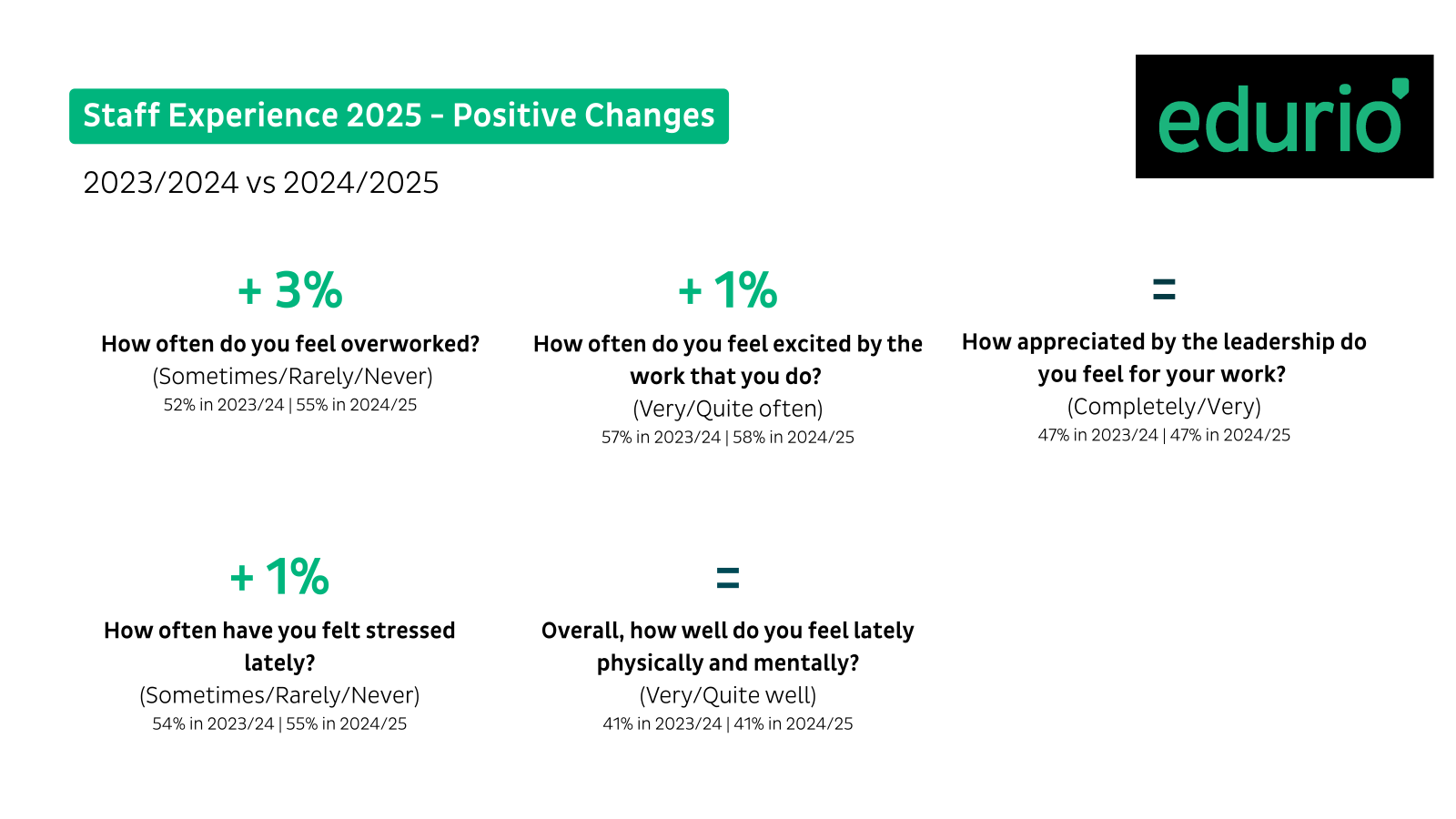
At the same time, teachers remained the least positive group on several core experience measures. Even with some encouraging movement, the underlying message is clear: many of the factors linked to retention are not hidden. They are already visible in how staff experience their work.
The latest NFER report also adds useful nuance on workload. Teachers’ average working hours have fallen modestly in recent years, but they remain higher than for similar graduates. In 2024/25, full-time teachers reported working 44.4 hours per week, four hours more than similar graduates. Around one in four teachers said they had an acceptable workload, up from 17% in 2021/22. That is a real improvement, but hardly a sign that the issue has been solved.
This is where listening becomes more than a cultural nice-to-have. It becomes a prevention measure.
Schools and trusts cannot control the national teacher labour market. They cannot single-handedly fix training shortfalls, national pay policy or regional recruitment challenges. But they can get much better at hearing staff voice early, identifying where dissatisfaction is concentrated, and acting before problems escalate into resignations, vacancies and costly short-term fixes.
That is the role Edurio can play. Not as a tool that predicts exactly who will leave, but as one that helps leaders understand the conditions that make leaving more likely. When staff can see that their views are being heard, and when leaders can pinpoint issues around workload, recognition, morale, leadership support or flexibility, they are in a much stronger position to respond early.
From reactive to preventative retention
In practice, that means moving from reactive retention to preventative retention. Instead of waiting for vacancies to appear, schools and trusts can identify patterns across roles, teams or schools, benchmark them, and act where the risk is highest. That could mean addressing workload in one phase, strengthening line-management support in another, or responding to concerns about appreciation and morale before they harden into exit decisions.
In a sector where replacement is still difficult and often expensive, prevention matters. The cost of teacher turnover is not only in the staff who go. It is in the instability, agency spend, leadership distraction and added pressure left behind. Listening early is one of the few levers schools and trusts can use before those costs arrive.
And that may be the strongest argument of all for staff voice: when leaders hear concerns early and respond well, they are not just improving staff experience. They are protecting organisational capacity, financial resilience and, ultimately, the quality of education pupils receive.
The main change here is that the external context is now more balanced: things have improved, but the pressure is still real. That makes the prevention argument stronger, not weaker.