 Share
 Share
 Share
The Edurio National Pupil Feedback in Action Award recognises schools across England where pupils are most likely to say their opinion is valued, based on nationally benchmarked survey data.
November puts pupil voice on the agenda. School councils have just been elected, and UK Parliament Week gives schools a natural moment to talk with pupils about how decisions get made. The harder test for leaders is whether pupils still believe their views count once the elections are over.
Edurio runs staff, pupil and parent surveys for schools and trusts across England, benchmarking each school’s results against national data. Part of Edurio’s national awards programme, this award recognises the schools where pupils are most confident that their opinion is valued. This year’s award draws on pupil feedback from 759 schools nationwide.
As Ernest Jenavs, CEO at Edurio, explains:
“Congratulations to the winners of the National Pupil Feedback in Action Award. Across England, only around one in ten pupils say their opinion is very valued at school, and the figure falls as pupils get older. In the winning schools, staff act on what pupils tell them and make sure pupils can see what has changed.”

Ernest Jenavs
CEO & Co-founder of Edurio
How the winners were chosen
The award is based on pupils’ answers to one question in Edurio’s pupil survey: “How valued do you think pupil opinion is in your school?” The winners are the top 10 primary schools and the top 10 secondary and sixth form schools in England for this question, out of 759 participating schools. The results draw on pupil responses from the 2025/2026 academic year, and schools needed at least 25 respondents to the question to be eligible. Both lists below are in no particular order.
Celebrating excellence: The National Pupil Feedback in Action Award winners
Primary winners
- The Ted Wragg Multi Academy Trust – Whipton Barton Federation
- Windsor Academy Trust – Goldsmith Primary Academy
- Endeavour Learning Trust – Woodlea Junior School
- Windsor Academy Trust – Colley Lane Primary Academy
- Ivy Education Trust – Kenn Church of England Primary School
- Windsor Academy Trust – Milton Primary Academy
- Windsor Academy Trust – Greenways Primary Academy
- The Ted Wragg Multi Academy Trust – Marine Academy Plymouth – Primary and Nursery
- Windsor Academy Trust – Rivers Primary Academy
- Place Partnership (formerly Accord Multi Academy Trust) – Middlestown Primary Academy
Secondary and sixth form winners
- Brigantia Learning Trust – Longley Park Sixth Form Academy
- Nova Education Trust – Melton Vale Sixth Form College
- The Ted Wragg Multi Academy Trust – Lipson Co-operative Academy
- Trinity MAT – Trinity Sixth Form Academy
- Maiden Erlegh Trust – River Academy
- Windsor Academy Trust – Great Wyrley Academy
- Endeavour Learning Trust – Tarleton Academy
- Swakeleys School for Girls
- Collaborative Education Trust – Langley School
- Affinity Learning Partnership – The de Ferrers Academy
Trusts with several winning schools
More than half of the 20 winners come from just three trusts. Windsor Academy Trust has six winning schools, five primary and one secondary. The Ted Wragg Multi Academy Trust has three and Endeavour Learning Trust has two, each spanning both phases. When pupils in several schools across one trust say their opinion is valued, it points to a shared approach rather than the work of one exceptional school. Windsor’s leaders describe below how they have embedded pupil voice into school improvement.
What this award measures, and why it matters
Pupils quickly notice when a survey or a school council leads nowhere. Asking how valued they think pupil opinion is tests whether pupils have seen their views make a difference, not only whether they were asked.
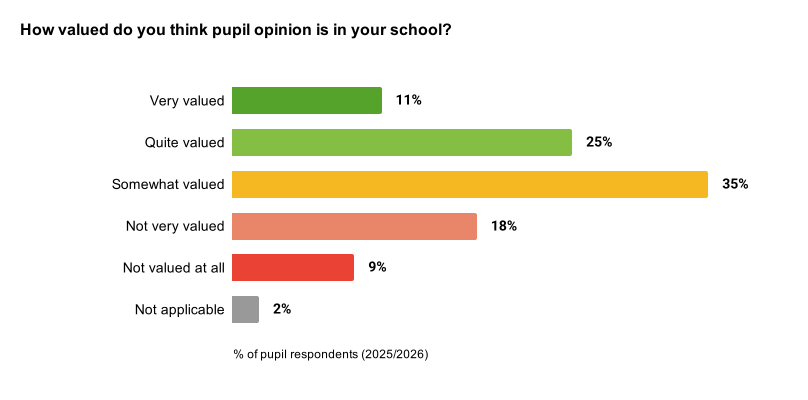
Nationally, 36% of pupils say pupil opinion is very or quite valued in their school, and only 11% say it is very valued. Almost as many, 9%, say it is not valued at all.
The figure also changes with age. It peaks at 57% in Year 6 and falls to 26% by Year 11, so the pupils closest to leaving school are among the least likely to feel heard. In Years 12 and 13, the figure is 42% and 37%. The secondary and sixth form winners show that this decline is not inevitable: in these schools, older pupils rate how valued their opinion is among the highest in England.
What schools gain from acting on pupil voice
When pupils can see their feedback acted on, schools gain:
- Earlier warning of problems with behaviour, safety or lessons, which pupils often notice before they show up in other data.
- Better decisions, because changes shaped by pupils are more likely to work for the people they affect.
- Stronger relationships, as pupils who see their views taken seriously have more reason to trust the adults around them.
- A first lesson in democracy, as a school council that leads to visible change shows pupils that taking part is worth it.
In their own words: what made the difference
We asked the winning schools what had made the biggest difference to how valued their pupils feel. One theme ran through almost every answer: pupils need to see what happens after they share their views, not only be asked for them.
“The key difference has been embedding pupil voice directly into our school improvement journey rather than treating surveys as a standalone exercise. By analysing detailed benchmark data across learning engagement, relationships and wellbeing, our school leaders actively address pupils’ needs so students see that their opinions genuinely shape their daily school experience.”
“Listening to student feedback has strengthened the trust between students and teachers. A positive rapport between students and staff allows us to better support our students to be successful.”
“The children feel that they have a voice and that their views are listened to. All classes have School Council representatives and they run class council meetings and then this is fed back to the School Council. During Class Councils, all children have the opportunity to bring up things that are important to them with the councillors making notes to take back to the whole school meeting. There are a range of other child leadership roles in school where the children have the opportunity to make an impact on the school community, subjects and environmental issues. Children apply for roles that they are interested in, and they work closely with staff leading these areas to continue to improve the school in these areas.”
“At Longley Park, we’ve worked hard to create a culture where student voice is not something we do occasionally, but an integral part of how we improve. We actively seek feedback from students throughout the year and, most importantly, we make sure they can see the impact of their contributions. Whether it’s improvements to learning spaces, enrichment opportunities, wellbeing support, communication, or teaching and learning, students know their views are valued and acted upon. That visibility has helped build us and encourages even greater engagement with the process.”
“We treat feedback as a conversation, not a survey. Students see what we’ve done with what they told us, and they’re honest when we haven’t got it right yet. That trust shows in our March 2026 results, where students rated “my opinion is valued” above the national average.”
“As a school we introduced monthly meetings between the headteacher and School Council representatives some time ago and over time this has become an increasingly meaningful dialogue as pupils began to see change in action. The headteacher shares outcomes from each meeting with key staff who respond and these actions are covered as updates in the following meeting. The feedback loop means that pupils trust the process. Pupils are also involved in key decision making such as planning for the introduction of a sixth form next year. As a Trust, we are spreading this practice by introducing a Youth Parliament this term with a remit to ‘raise our pupils’ voices’, giving our children and young people the agency to represent their peers, improve things in school and make a difference to their wider communities.”
At River Academy, we work very hard each and every day, making the students feel valued and celebrating all of the small wins. Students are known and noticed through these daily micro-celebrations at line-up, in tutor time, in assembly and via Golden Phone calls home. We work very hard on building positive relations with our students through things such as morning greetings, duties and afternoon farewells. Therefore, our students have many, many opportunities each day to interact positively with staff and raise any matters of note. On top of this positive school culture, we have our more formal structures of class and school councils that allow students to discuss any more earnest matters. As a Headteacher, I will always meet the school council to follow up on their requests and ideas.
“At Kenn, our Christian vision and values of kindness, courage and faith are lived out through the choices we make every day. We want our pupils to know that their voices matter and that they can make a real difference to the lives of others. Through ‘We Are Ivy Week’, pupils have the opportunity to suggest, plan and lead activities that benefit their school and wider community. These have included organising a cream tea for residents in the village, spending time supporting younger children at a local pre-school, leaving kindness pebbles with positive messages around the village to brighten people’s days, and improving our school environment through gardening, painting fences and creating more welcoming spaces for learning.
These experiences help children see that their ideas can lead to meaningful action. They develop confidence, responsibility and teamwork, while learning that even small acts of kindness can have a positive impact. For us, acting on pupil feedback is about more than listening to children’s views; it is about giving them genuine opportunities to put our Christian values into practice and see the difference they can make.”
Recommendations from award-winning schools
We also asked each school for the one thing they would recommend to other schools and trusts that want pupils to feel their opinion is valued.
“I would recommend moving beyond simply gathering pupil feedback to giving children genuine opportunities to act on it. At Kenn, we encourage pupils to take ownership, make decisions, and lead initiatives that benefit others. Through fundraising for charities, supporting their community and taking on leadership roles within school, pupils develop valuable skills for later life while learning that their voices and actions matter. When pupil feedback is acted upon, children see that they are valued members of their school community and that they have the power to make a positive difference.”
“The biggest change has been moving beyond simply collecting feedback to consistently closing the feedback loop. Gathering student views is important, but demonstrating what has changed as a result is what makes the real difference. We regularly share “You Said, We Can All Do” updates with students so they can see how their feedback has influenced decisions but also ensure that there are actions in there for students too – it’s a collective drive to improve. This has strengthened student participation, increased confidence that their voices matter, and helped us make more informed improvements across the academy.”
“I recommend creating a structured “feedback-to-action” cycle where survey results are transparently shared back with staff and pupils to co-create targeted actions. Explicitly closing the feedback loop builds trust across the whole school community and turns pupil sentiment into measurable growth.”
“The pupil leadership roles are not always from Y6 as, when they leave, the school is left to recruit and re-train new leaders. We therefore recruit pupil leaders from lower years as well and then these act as role models and mentors for the new recruits. This has meant the academy has future-proofed the pupil leadership team so there are no gaps in pupil voice.”
“Take the survey results back to the students. Each term, small groups meet senior leaders over tea (we call it SLTea) to discuss our Edurio findings: why a score has moved and what we should do about it. That turns the data into a plan that students help shape and own.”
“A range of student feedback opportunities is important for students to feel they are listened to. Student surveys combined with school council and focused student voice meetings combine to improve the communication between staff and students.”
“Do everything possible to create the conditions for school to be a calm, safe space where students can learn, make friends, exercise and enjoy their adolescence.”
Learn from award-winning schools
Our best-practice guide shares how our 2025 award-winning schools act on feedback from staff, pupils and parents, and how they show each group what changed as a result.
How do I win an award?
Every Edurio award is based on nationally benchmarked feedback from staff, pupils or parents. Read our blog post on how Edurio awards work.
Find out how valued your pupils feel
Edurio’s pupil surveys show how your pupils’ experience compares with schools across England, year group by year group, so you can see where pupil voice is working and where pupils feel unheard.